
In an Era where Artificial Intelligence is reshaping the world, many beginners are eager to dive into this exciting field. One of the most critical first steps is choosing the right programming language to learn. In this context, Python emerges as an ideal choice. Let’s take a closer look at the reasons that have made Python so influential and appealing in the age of AI.
1 What is Python?
Python is a high-level, versatile programming language that's easy to read and is used for building web applicaitons, software, automating tasks, data analysis, and developing artificial intelligent (AI).
Popular Applications:
- Web Development (Backend)
- Data Science & AI/Machine Learning
- Task Automation
- Simple Software & Game Development
2. The Popularity of Python
Python is now widely recognized as one of the most commonly used programming languages in artificial intelligence. Just as English has become the global language of human communication, Python has emerged as the universal language for AI.
Familiar applications like Instagram, Netflix, Spotify, and even ChatGPT clearly showcase the significant impact of Python. This influence is no coincidence. It stems from a powerful combination of Python’s concise and readable syntax, along with its vast and mature ecosystem. This makes programming easier than ever, bolstered by substantial investments from tech giants like Google, Meta, and Microsoft.
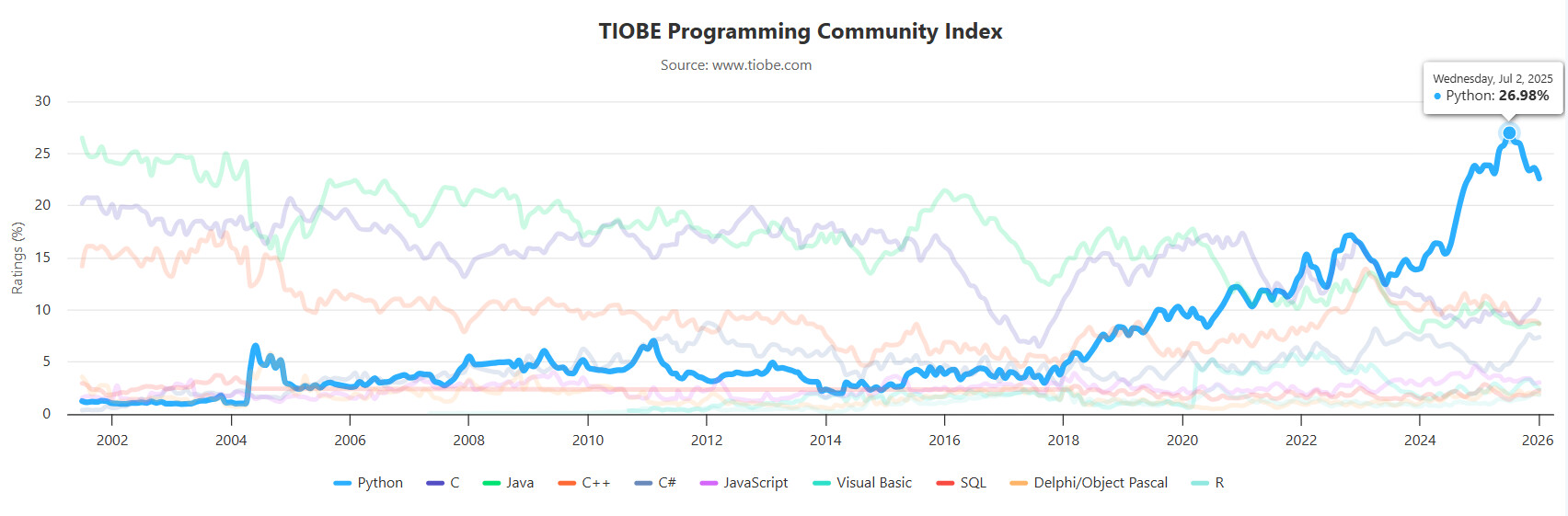
Image 1: As of July 2025, Python reached 27% on the TIOBE index - the highest score since the ranking was first introduced in 2001
Note. From "TIOBE Index," by TIOBE Software BV, as of January 2026 (https://www.tiobe.com/tiobe-index/). Copyright 2026 by TIOBE Software BV
3. User-Friendliness
One of the most important criteria when learning AI at AIO is focusing on algorithmic thinking. Python was designed precisely to support that goal. Instead of struggling with complex structures and syntax code, Python allows you to write code syntax that feels almost like writing English.
Let take a simple instance: To print the words “Hello AIO”:
Python
print("Hello AIO")
Java
public class Hello {
    public static void main(String[] args) {
        System.out.println("Hello AIO");
    }
}
C++
#include <iostream>

int main() {
    std::cout << "Hello AIO" << std::endl;
    return 0;
}
4. The Python ecosystem
If Python is the language of AI then its libraries are its vocabulary. These prebuilt tools allow developers to accomplish in just ten lines of code which would normally require thousands. Libraries can be compared to kitchen appliances: you don’t need to understand how a blender works internally in order to make a smoothie
Below is a brief introduction to some of Python’s most important AI Libraries:
- NumPy: Enables efficient and intuitive handling of complex mathematical and numerical structures.
- Pandas: Powerful Data Structures such as DataFrames, making data analysis and manipulation significantly easier and more intuitive.
- Matplotlib: Data Visualization tool for creating static, animated with interactive charts and graphs.
- Scikit-learn: Offers a comprehensive collection of tools and algorithms for Machine Learning, covering tasks such as classification, regression, dustering, and model evaluation.
- TensorFlow: Developed by Google, this library provides a robust and scalable platform for building and deploying Neural Networks and large-scale machine learning models.
- PyTorch: An open-source library developed by Meta, well known for its flexibility and highly ‘Pythonic” design. PyTorch makes experimentation and the construction of complex Deep Learning models more intuitive and developer-friendly.
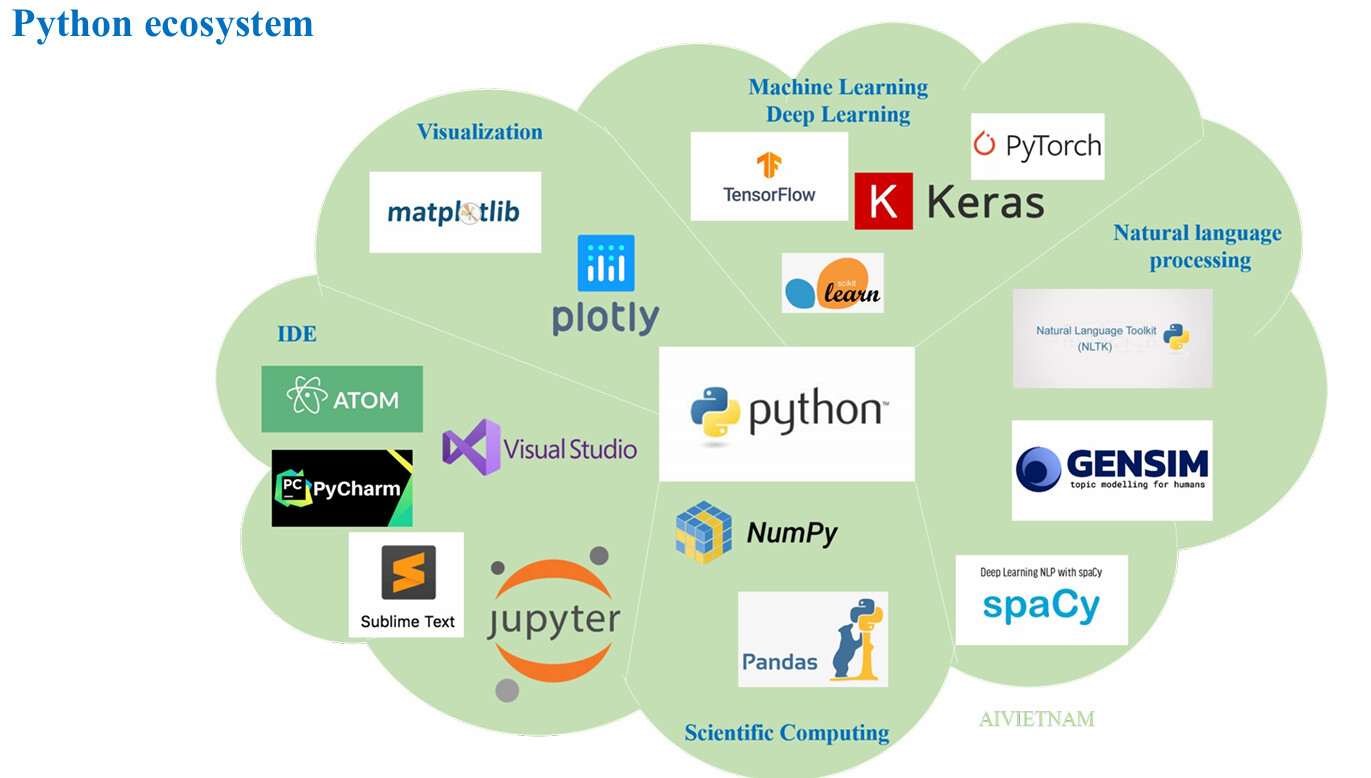
Image 2 (AIO, 2025)
5. Similarities Between Python and Mathematics
At AIO, we always emphasize understanding the mathematical foundations behind every line of code. Python is one of the rare programming languages where the correspondence between mathematical formulas and programming syntax is exceptionally strong.
Example:
Linear Regression: $$\hat{y} = wx + b$$
def predict(x, w, b):
    return w * x + b

# With multiple features
y_hat = np.dot(w, x) + b
Sigmoid Activation Function in Neural Networks: $$\sigma(x) = \frac{1}{1 + e^{-x}}$$
import numpy as np

def sigmoid(x):
    return 1 / (1 + np.exp(-x))
Dot Product: $$\mathbf{a} \cdot \mathbf{b} = \sum_{i=1}^{n} a_i \cdot b_i$$
# Method 1:
dot = sum(a[i] * b[i] for i in range(len(a)))

# Method 2: Using Numpy
dot = np.dot(a, b)

# Method 3: Operator @
dot = a @ b
5. A Strong Community
Thanks to its widespread adoption, Python has naturally fostered a vibrant and highly active global community. With approximately 24,4 million developers using Python worldwide (Bicaj et al., 2025), chances are that almost any bug or issue you encounter has already been faced-and solved -by someone else. Solutions can easily be found on platforms such as Stack Overflow or GitHub.
Major technology companies actively use and contribute to Python’s AI ecosystem, including Google (TensorFlow, Colab, TPU), Meta (PyTorch), Microsoft (Azure ML), Amazon (SageMaker), and Netflix. Their continued investment not only strengthens Python’s tooling but also drives innovation across the entire AI Landscape.
From free courses on YouTube and structured programs on Coursera to hands-on projects in open-source communities, learning resources for Python in AI are virtually limitless. Whether you prefer video tutorials, interactive notebooks, or real-world codebases, the Python ecosystem offers learning paths suited to every level and learning style
Image 3. Major learning platforms: datacamp, udemy, coursera, youtube, github and stackoverflow
6. Weaknesses of Python
Of course, nothing is perfect. One of Python’s commonly cited drawbacks is its slower execution speed compared to compiled languages such as C++. This is largely because Python is an interpreted language, meaning code is executed line by line at runtime rather than being compiled directly into machine code.
However, modern AI libraries have addressed this limitation in a very intelligent way. The computationally intensive core components are typically written in C or C++, while Python is used as a high-level control and orchestration layer. This design allows developers to enjoy the simplicity and productivity of Python while still achieving near-optimal performance when processing Big Data and Complex Models.
7. Conclusion
Python’s dominance in the AI landscape highlights a significant victory for accessibility over raw performance. It doesn’t excel by being the fastest or most memory-efficient language; instead, it thrives by making AI development feasible and practical for millions, including researchers, multidisciplinary students, and aspiring product builders who may lack formal training in computer science.
Developers gravitate towards Python because it offers the best tools available, while tool builders favor Python because that’s where the developers are. This mutually reinforcing cycle has fostered a remarkably strong and resilient ecosystem. With 72% of machine learning engineer job postings requiring Python (Magnet, 2025), 85% of deep learning research papers utilizing PyTorch (Hayes, 2025), and major AI companies continuing to invest heavily in Python-based tools, its leading position shows no signs of weakening.

Image 4. Python Roadmap (Lukesh, 2025)
Note. From "Master Python for Data Science in 2025: A Complete Guide," by L. S., 2025, GUVI Geek Network (https://www.guvi.in/blog/python-for-data-science/). Copyright 2025 by HCL GUVI Geek Network Private Limited.
A sensible learning path begins with a solid foundation in Python fundamentals, followed by data processing with NumPy and Pandas, then machine learning with Scikit-Learn, and finally deep learning with PyTorch or TensorFlow. It’s important not to skip steps. Focus on building real-world projects to develop a deep understanding instead of relying solely on theory. With persistence and a reasonable investment of time, mastering AI is well within reach.
Python is the gateway to the world of artificial intelligence. Master it, and you'll unlock countless opportunities in one of the most rapidly growing fields of our era.
References list
Bicaj, B., Bollmann-Dodd, L., & Korakitis, K. (2025). 24.4 million developers using Python worldwide Q3, 2025. SlashData. https://www.slashdata.co/free-industry-reports/sizing-programming-language-communities
Hayes, D. (2025, June 16). TensorFlow vs PyTorch: A comparative analysis for 2025. Leapcell. https://leapcell.io/blog/tensorflow-vs-pytorch-a-comparative-analysis-for-2025
Lukesh, S. (2025, October 22). Master Python for Data Science in 2025: A complete guide. GUVI Geek Network. https://www.guvi.in/blog/python-for-data-science/
Magnet, S. (2025, April 24). Machine learning engineer job outlook 2025 [Research on 1,000 job postings]. 365 Data Science. https://365datascience.com/career-advice/career-guides/machine-learning-engineer-job-outlook-2025/
TIOBE Software BV.(2026). TIOBE Index. Retrieved January 2026, from https://www.tiobe.com/tiobe-index/
Chưa có bình luận nào. Hãy là người đầu tiên!