
What Do You Study in AI? A Roadmap from Zero to Getting a Job (What to Learn – How Long It Takes – What You Can Do)
Source: Image created by Gemini.
Have you ever noticed how Artificial Intelligence (AI) quietly “seeps into” your everyday life?
From how Netflix recommends movies you’ll love, to how Shopee suggests products that match your taste—have you ever wondered why AI chatbots like ChatGPT can write an entire essay or generate images from a single prompt in just seconds?
AI has become a global trend and one of the hottest modern fields to study.
However, for beginners, the jungle of terms like Machine Learning and Deep Learning can feel overwhelming. Many people ask:
“Do I need to be good at math to learn AI?”
“Can I learn AI if I don’t know how to code yet?”
If you’re thinking the same, then this article is for you.
Table of Contents
- What is AI? Why is AI worth learning?
- Common myths about AI vs. the truth
- Where to start learning AI (What to learn + tools + projects)
- How long does it take to “be able to do AI”?
- Suggested learning roadmap + recommended courses
- Essential skills in AI
- What can you do after learning AI?
- Start your AI journey today
What is AI? Why is AI worth learning?
Artificial Intelligence (AI) is a transformative technology that enables computers and devices to simulate learning, understanding, problem-solving, decision-making, creativity, and autonomy in ways that resemble human intelligence.
In the simplest terms:
- AI (Artificial Intelligence) is the ability of machines to learn and make decisions like humans to some extent.
- Instead of coding rules like “if A then B”, AI learns patterns from data and finds rules automatically.
Here are some real-life examples:
- Netflix learns from what you watch → then recommends content you might like.
- Shopee analyzes what you browse and purchase → then suggests products that fit you.
- ChatGPT learns from massive text data → then can answer questions, write content, and summarize in seconds.
Thanks to the explosion of data and computing power, AI is becoming more popular than ever and is being applied in many fields such as:
- Finance
- Healthcare
- Education
- Marketing
- Business operations
Here is a “controversial but interesting” perspective on how fast technology is evolving:
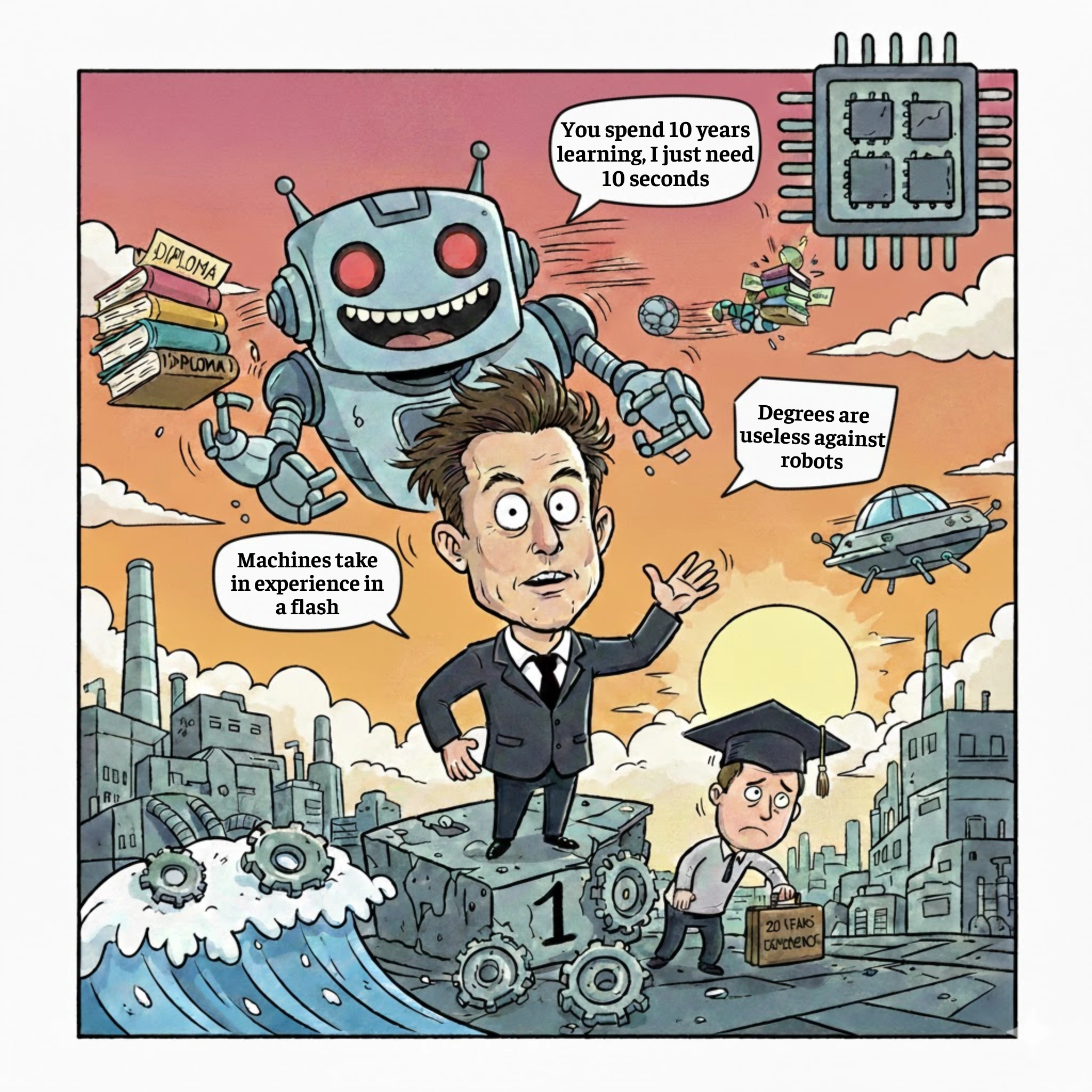
Source: Image created by Gemini.
“By 2030, 10 years of training won’t be as valuable as what AI can learn in 10 seconds; degrees will become useless before robots; 20 years of experience can be absorbed instantly by machines.” — Elon Musk
This statement may sound extreme, but it reflects one key truth:
AI is evolving fast, and people who can leverage it early will have a strong advantage in study and work.
Today, companies integrate AI into their workflows to boost productivity, optimize processes, and leverage large-scale data for better decision-making. According to Grand View Research, the global AI market reached $390.91 billion** in 2025 and is expected to grow to **$3,497.26 billion by 2033.
Common myths about AI vs. the truth
The biggest barrier for beginners is fear—driven by common myths such as:
“You must be great at math”, “AI is only for geniuses or IT people”, or “AI is too far away from my ability.”
Is that true? Not at all.
| Myth | The truth |
|---|---|
| You must be great at math | Math matters, but you only need core concepts—not advanced proofs. |
| AI is only for IT people | AI can be a “smart assistant” for everyone: business owners, marketers, students, etc. |
| AI is too far away | AI is already right next to you—just one tap away. |
Understanding AI correctly helps beginners feel less intimidated, learn in the right direction, and stop limiting themselves too early.
“You don’t need to be a genius to learn AI. You just need to start the right way and stay consistent.”
If you want me to write a 3-month AI roadmap from zero, comment AI so I know!
Where to start learning AI?
When people hear “AI”, they often think of complex concepts and advanced terms. But at the beginning, you only need to focus on a few key foundations.
Quick checklist: What do you learn in AI?
- [ ] Math foundations (Linear Algebra, Calculus, Probability & Statistics)
- [ ] Basic Python
- [ ] Data processing (Pandas, NumPy)
- [ ] Machine Learning (Regression / Classification / Clustering)
- [ ] Deep Learning (PyTorch or TensorFlow)
- [ ] Practice datasets (Kaggle, UCI)
- [ ] Small projects to build your portfolio
If you master this checklist, you’ll already have a solid foundation to learn AI seriously.
1. Math fundamentals
Key math topics include Linear Algebra, Calculus, and Probability & Statistics.
Your goal is not to prove formulas, but to understand key concepts well enough to apply them.
2. Programming
AI uses many programming languages, but Python is the most widely used.
You don’t need to become a professional software engineer—just learn how to process data and write simple code.
3. Core AI knowledge
After building a foundation in math and Python, you can start learning AI basics:
Machine Learning (ML)
Machine Learning teaches computers to learn from data and make predictions.
Example: Housing price prediction; Spam email detection.
Deep Learning (DL)
Deep Learning is a “stronger” approach for complex data like images or audio.
Example: Face recognition; Chatbots; Generative AI like ChatGPT.
A fun way to remember it:
AI is the universe
ML is a planet
DL is the busiest city on that planet
4. Beginner toolset (What tools should you use for AI?)
If you’re not sure what to use, here is a simple “starter kit”:
- Python: Google Colab (free, runs in browser) or Kaggle Notebook
- Data processing: Pandas, NumPy
- Machine Learning: scikit-learn
- Deep Learning: PyTorch or TensorFlow
- Datasets: Kaggle Datasets, UCI Machine Learning Repository
This is more than enough to begin learning and building small projects.
5. Common types of AI projects (learning with real outcomes)
When learning AI, you’ll often work on these common project types:
- Regression: predicting house prices, revenue, scores…
- Classification: spam detection, diagnosis, churn prediction…
- Clustering: customer segmentation, behavior grouping…
- Computer Vision: image recognition, object detection, face detection…
- NLP: sentiment analysis, chatbots, text summarization…
💡 Tip:
A good project doesn’t need to be “insane”.
Just follow the process:
Get data → clean data → train model → evaluate → document on GitHub/portfolio
How long does it take to “be able to do AI”?
This is the #1 beginner question.
The honest answer: there is no universal number, because it depends on how consistently you study and what level you want to reach.
But don’t worry—AI is not only for geniuses. If you learn step by step and stay consistent, you will improve faster than you think.
Here’s a realistic timeline:
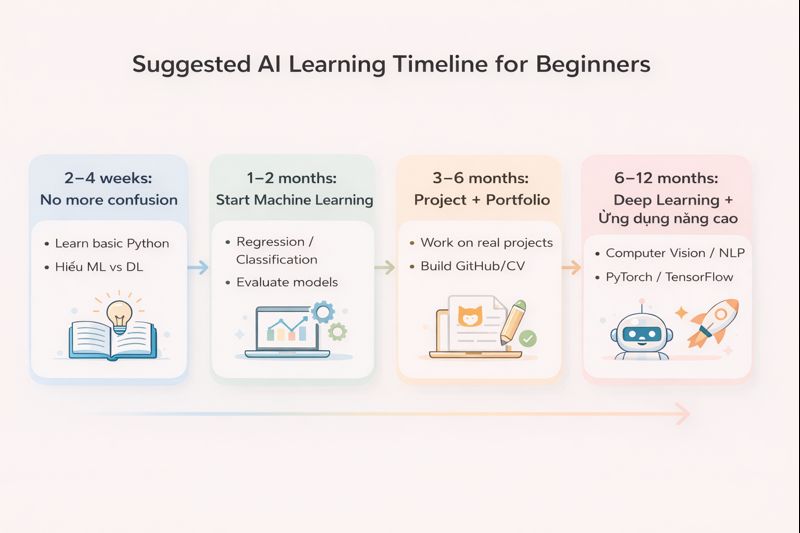
Source: Image created by GPT.
Stage 1 (2–4 weeks): “No longer confused”
Your goal is not to build powerful AI yet, but to stop feeling overwhelmed.
You will learn:
- Basic Python (loops, functions, lists, file reading)
- What data is + simple data processing with Pandas
- Basic understanding of AI vs ML vs DL
After this stage, you’ll likely think:
“Oh… AI isn’t as scary as I thought.”
Stage 2 (1–2 months): “Start doing Machine Learning”
This is where you begin training real models.
You will learn:
- What model training means
- Basic regression & classification
- Model evaluation (accuracy, precision, recall…)
Mini projects you can do:
- House price prediction
- Spam classification
- Churn prediction
You’ll start feeling:
“Wait… I can actually do this!”
Stage 3 (3–6 months): “Real projects + portfolio”
At this point, you stop learning only to “know” and start learning to “build”.
You will improve:
- Better data preprocessing
- Choosing models for the right problems
- Tuning and avoiding overfitting
- Building proper ML pipelines
Example projects:
- Customer segmentation
- Sales prediction
- Basic recommendation system
- Any project close to real life
This is when you can start:
- Writing your CV
- Building GitHub
- Applying for internships (depending on your background)
Stage 4 (6–12 months): “Deep Learning and the next level”
If you want to go into:
- Computer Vision
- NLP
- Chatbots
- Generative AI
You’ll learn:
- Deep Learning (CNN, RNN/Transformers)
- PyTorch or TensorFlow
- Basic CV/NLP pipelines
Projects may include:
- Face/object detection
- Document Q&A chatbot
- Sentiment analysis
- AI apps for your favorite topic
This is where you begin to feel like a real AI practitioner.
So how long until you can get a job?
A practical estimate:
- 3–6 months: build projects and start applying for internships
- 6–12 months: apply for fresher/junior roles with a strong portfolio
- 1+ year: specialize into ML Engineer, Data Scientist, LLM Specialist…
One key secret:
In AI, the fastest learners are not the ones who study the most—they’re the ones who build the most projects.
You don’t need to be good at the start.
You just need to start—and improve a little every day.
Suggested learning roadmap + recommended courses
If you want a clear path and don’t want to waste time, here are two common approaches:
1) Learn fast to build projects (0 → portfolio)
Best if you want practical results quickly.
- Learn Python + data tools (Pandas, NumPy)
- Practice basic Machine Learning
- Build 2–3 small projects for GitHub/portfolio
- Then move into Deep Learning / LLMs later
2) Learn deeply and build strong foundations
Best for long-term paths like ML Engineer / Data Scientist / Research.
- Math foundations: Linear Algebra + Probability
- Solid ML: models + metrics + overfitting
- Deep Learning: CNN / Transformers, PyTorch
- Read papers + advanced projects
3) High-quality AI courses (including AIO)
If you don’t want to learn randomly, following structured courses saves time:
- AIO (AI Viet Nam) – structured roadmap + community/mentors
- Machine Learning Specialization – Andrew Ng (Coursera)
- Deep Learning Specialization – Andrew Ng (Coursera)
- CS50’s Introduction to AI with Python (Harvard/edX)
- Kaggle Learn – practice Python/Pandas/ML and find datasets
💡 Small advice:
No matter which course you choose, follow this rule:
- 70% practice – 30% theory
- Build at least 2–3 projects
- Write them into GitHub/portfolio for internships and fresher roles
Essential skills in AI
Many people think AI is only about technical skills. In reality, both hard skills and soft skills matter.
- Hard skills: math, Python, ML/DL algorithms, model evaluation
- Soft skills: problem-solving mindset, logical thinking, asking the right questions, AI ethics
A technically good model that solves the wrong real-world problem creates no value.
What can you do after learning AI?
According to World Economic Forum (WEF) and Acedit, AI job opportunities expanded significantly in 2025.
However, each role fits a different type of person. Here’s a realistic overview to help you choose a path:
Which AI career path should you choose?
AI is broad, but you can choose a direction that matches your strengths.
Some common paths include:
- Data Analyst → the easiest entry for beginners
- Great if you enjoy working with data, visualization, reporting, and insights.
-
Less math-heavy; logical thinking is more important.
-
Machine Learning Engineer → more technical, stronger coding needed
- Build, optimize, and deploy ML models into real systems.
-
Requires solid programming skills and ML pipelines knowledge.
-
LLM / Prompt Engineer → great if you like writing & product building
- Design prompts, optimize chatbot interactions, build LLM applications.
-
Not necessarily math-heavy, but you need strong “question design” skills.
-
AI Research (Research Scientist) → math-heavy, paper-reading intense
- Focus on new algorithms and model improvements.
- Best for those who enjoy deep learning and academic study.
There is no “best” direction—only the one that fits you best.
Choosing the right path helps you learn the right things and avoid burnout.
Start your AI journey today
If you made it here, you may have realized AI is not as “far away” as it seems.
The most important thing is: start and move step by step.
Just improve a little every day: learn a concept, do small exercises, and apply AI to real problems. You’ll see progress sooner than you think.
If you found this article useful, save it, share it with friends who are also curious about AI, and start your journey today—because AI won’t wait for anyone.
References
- Artificial intelligence market size. (n.d.). Industry report, 2033. Grand View Research. https://www.grandviewresearch.com/industry-analysis/artificial-intelligence-ai-market
- Băng, B. (2026, January 14). Elon Musk: Degrees, experience, and money will become useless in four years; people will need a new skill to survive. Markettimes. https://markettimes.vn/elon-musk-bang-cap-kinh-nghiem-hay-tien-bac-se-thanh-vo-dung-trong-4-nam-nua-con-nguoi-can-mot-ky-nang-moi-de-ton-tai-102337.html
- Chen, A. (2025, December 16). What skills will be most important for AI jobs in 2025? Acedit. https://www.acedit.ai/blog/ai-job-market-trends-expectations
- Google Gemini. (2026a). The image illustrates the AI era, connected to humans, with a minimalist and dynamic style. [AI-generated image]. Retrieved from https://gemini.google.com/
- Google Gemini. (2026b). Image illustrating Elon Musk with a robot. [AI-generated image]. Retrieved from https://gemini.google.com/
- OpenAI. (2026). Timeline for learning AI for beginners [AI-generated image]. ChatGPT. https://chat.openai.com/
- Stryker, C., & Kavlakoglu, E. (n.d.). Artificial intelligence. IBM. https://www.ibm.com/think/topics/artificial-intelligence
- The future of jobs report 2025. (2025, January 7). World Economic Forum. https://www.weforum.org/publications/the-future-of-jobs-report-2025/
Chưa có bình luận nào. Hãy là người đầu tiên!