
1. Why "Is learning AI difficult?" is a common question
In recent years, Artificial Intelligence (AI) has appeared everywhere: from chatbots like ChatGPT, Netflix's movie recommendation system, personalized ads on social media, to applications in healthcare, finance, and education. AI seems to be becoming an indispensable part of modern life.
As a result, increasing numbers of people wonder: with AI now so prevalent, can anyone learn it easily? Or is it still a daunting field accessible only to those with robust tech expertise? The question "Is learning AI difficult?" has therefore become a common concern, opening up an interesting conversation about opportunities and challenges in the journey to approach this field.
Many people are still hesitant when thinking about learning AI, because they believe this field is tied to difficult mathematical formulas or complex code, or is only for those with a really solid technology foundation. These very prejudices have caused many people to hesitate, even giving up before they've even started.
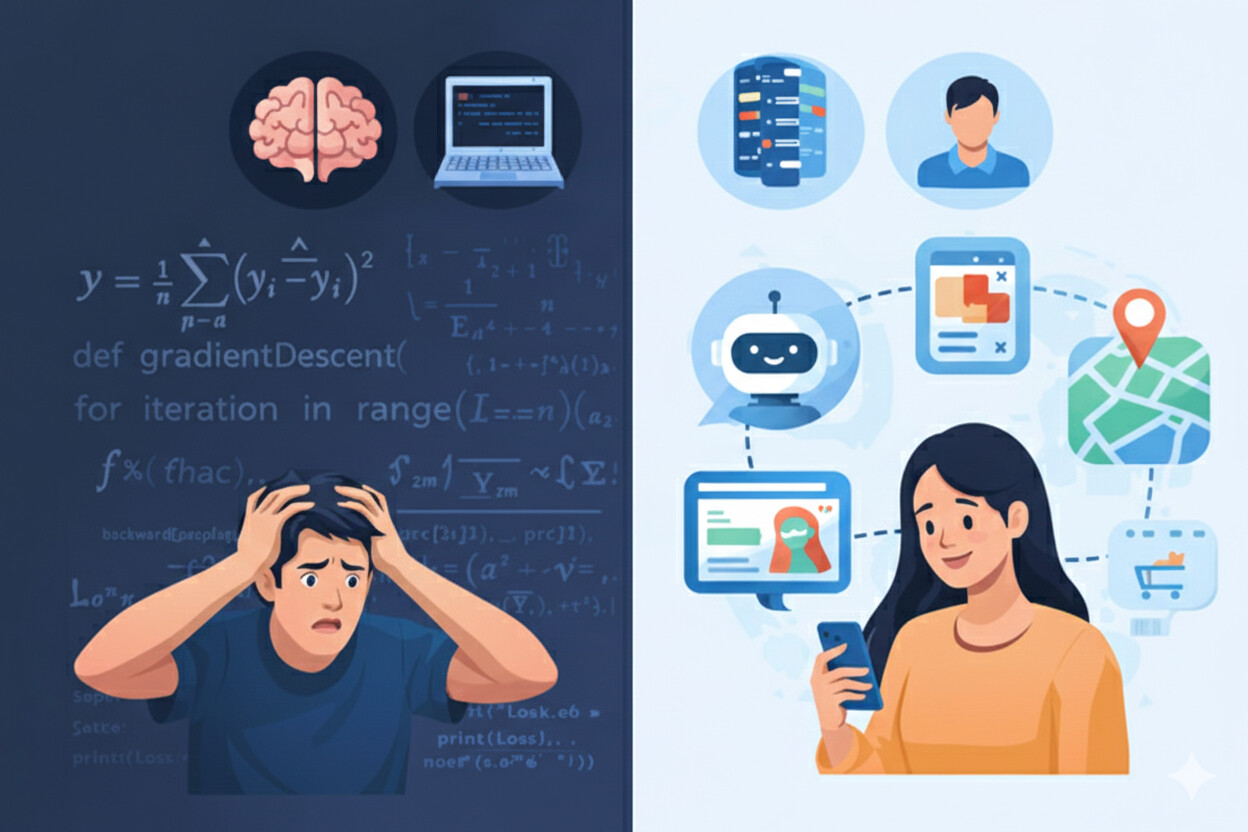
🎯 Article objective
To clarify a core issue: Is AI really difficult, or is it only difficult because we don't understand it correctly?
2. Understanding AI correctly: the most important foundation when starting
2.1. What is AI?
AI (Artificial Intelligence) is a field that develops systems capable of learning from data, recognizing patterns, and making predictions/decisions. Simply put, AI doesn't "think" like humans, but only calculates quickly based on data.
2.2. What AI is not?
AI is often misunderstood as:
- Robots with consciousness and emotions
- A system that is always correct in every situation
- Technology that is "naturally intelligent" without human control
In reality, AI depends entirely on data and how humans design the model. If the data is wrong or insufficient, AI will also produce wrong results.
2.3. Main branches of AI and difficulty levels
AI is not a unified block, but consists of multiple levels:
- Applied AI: using available AI tools (chatbots, data analysis, content generation)
- Machine Learning (ML): building models for machines to learn from data
- Deep Learning (DL): deep learning models, used in image recognition, voice recognition
Not everyone learning AI needs to delve into Deep Learning. For most users, applied AI is sufficient to create real value.
3. Why is AI hard to learn?
3.1 Mathematical Barriers
To understand AI deeply (especially Machine Learning and Deep Learning), we need solid knowledge of:
-
Linear Algebra
-
Calculus
-
Probability and Statistics
We need to not only know the formulas but also understand the geometric meaning and the transformation of data in multi-dimensional space.

3.2 The Feeling of Losing Logical Control
When learning programming, we are often used to the "If A then do B" (If-Else) mindset, meaning we are accustomed to writing our own rules and algorithms to perform desired tasks, having complete control over logic during the process.
However, in the process of learning AI, there are phases where we don't write rules but provide data for the model to find the rules itself to predict results or perform tasks. This feeling of losing logical control can make some beginners feel confused, not knowing if they are doing it right or wrong.

3.3 The "Black Box" Problem and Debugging
Debugging in the process of learning AI is not simple at all. During learning, we will have to build many prediction models with extremely complex, hard-to-explain logic (Black Box) and need to fine-tune many parameters and factors. Setting up unreasonable logic at a certain stage or making a wrong choice with just one of these many parameters/factors can lead to the model producing biased prediction results. And when the results are not as desired even though everything looks like it runs smoothly, we have to review the entire implementation process to check.

3.4 Rapidly Changing Knowledge
In the current AI era, what is considered the "standard" today may be obsolete next month. We have to face the situation where just after finishing learning a technology, before applying it, a new and better technology has already replaced it. The feeling of being "overwhelmed" and the fear of missing out (FOMO) is huge, making it easy to get discouraged and give up.

3.5 Data Processing
Unlike many people mistakenly believe that learning AI is just sitting and designing models, for the majority of the time, we have to clean data (Data Preprocessing). This data cleaning work requires meticulousness, is boring, and easy to cause discouragement, but it is one of the major factors deciding the success or failure of model building and prediction.

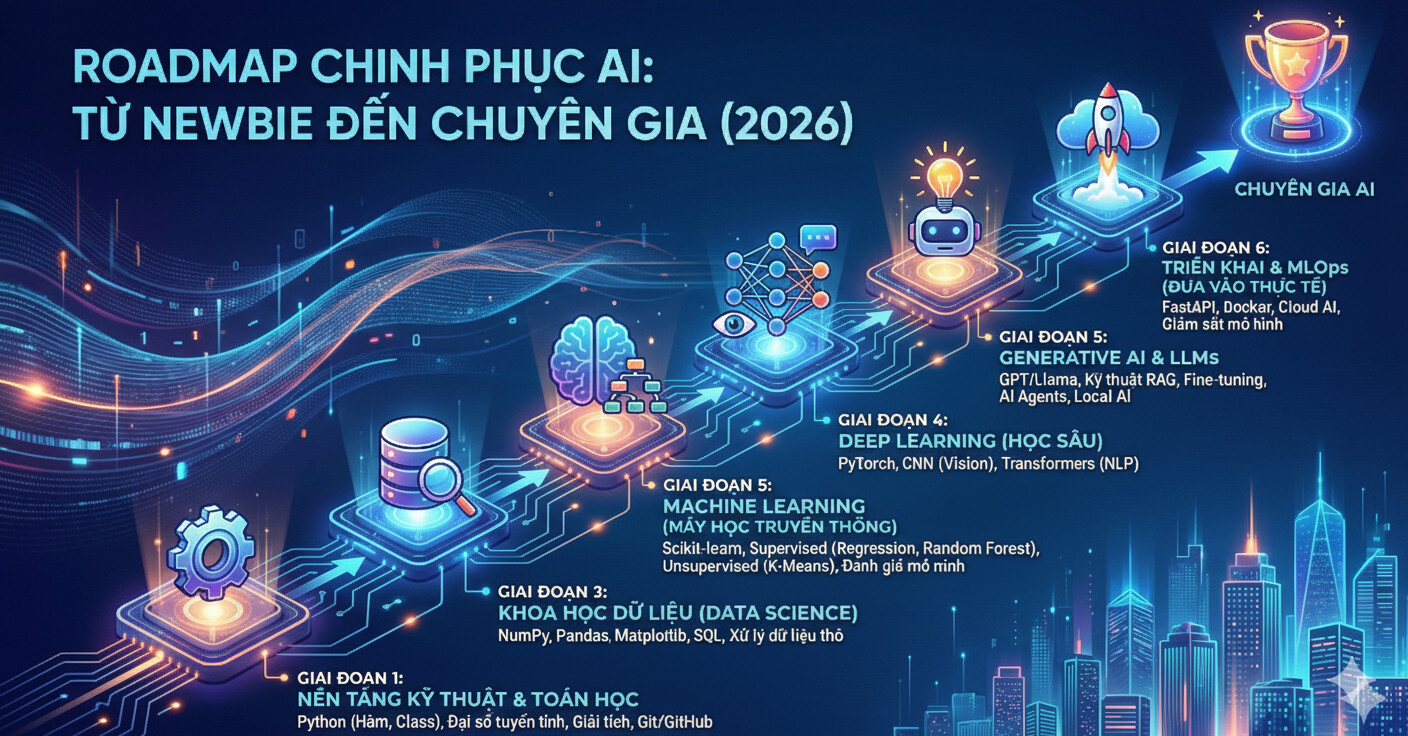
4. AI Mastery Roadmap: From Newbie to Expert
To go fast and far in the field of AI, the key is not to learn everything at once, but to follow a roadmap with a clear sequence. Below are 6 stages presented in increasing order of difficulty, helping you avoid burnout by focusing on one milestone at a time.
Stage 1: Technical & Mathematical Foundations
Before teaching a computer to learn, you must understand programming logic and the core mathematical concepts that power AI.
- Python Programming: Master essentials to advanced concepts (Functions, Classes, List Comprehensions, Decorators).
- Mathematics for AI:
- Linear Algebra: Matrices, Vectors, and Matrix Multiplication.
- Calculus: Derivatives and Gradient Descent (the core of model optimization).
- Probability & Statistics: Distributions, expectation, and standard deviation.
- Version Control: Become proficient in Git/GitHub.
Resources: KhanAcademy, Python for Everybody, CS50’s Introduction to AI with Python.
Stage 2: Data Science
Data is the "fuel" for AI. A model is only as good as the data it is trained on.
- Analysis Libraries: Master NumPy, Pandas, and Matplotlib/Seaborn.
- SQL: Essential for querying professional databases.
- Pre-processing: Learn to handle missing values, normalize/scale data, and perform basic Feature Engineering.
Resources: Data Science from Scratch: First Principles with Python.
Stage 3: Traditional Machine Learning
Start with algorithms that provide predictive power without the complexity of deep neural networks.
- Supervised Learning: Linear/Logistic Regression, Decision Trees, Random Forest, and XGBoost.
- Unsupervised Learning: K-Means Clustering and PCA (Dimensionality Reduction).
- Library: Become proficient in Scikit-learn.
- Evaluation: Learn to use metrics like Accuracy, Precision, Recall, and F1-score.
> Resources: Machine Learning - CS229, Hands-On Machine Learning with Scikit-Learn, Keras, and TensorFlow
Stage 4: Deep Learning
Step into modern AI, where we build architectures that simulate neural processing.
| Field | Core Technology | Applications |
|---|---|---|
| Framework | PyTorch (Recommended) or TensorFlow | Building neural network architectures. |
| Computer Vision | CNN, YOLO, ViT (Vision Transformer) | Facial recognition, medical imaging. |
| NLP | RNN, LSTM, and Transformers | Translation, sentiment analysis, chatbots. |
Resources: Deep Learning By Ian Goodfellow, Yoshua Bengio, Aaron Courville, Dive into Deep Learning, 3blue1brown
Stage 5: Generative AI & Large Language Models (LLMs)
The current frontier of AI, focusing on models that can generate human-like content.
- LLMs: Understand the architecture of GPT, Llama, and Gemini.
- RAG (Retrieval-Augmented Generation): Connecting AI with private data repositories.
- Fine-tuning: Techniques to refine pre-trained models for niche tasks.
- Local AI: Using tools like Ollama to run models locally on your hardware.
Stage 6: Deployment & MLOps
A model has real-world value only when it is deployed and accessible to users.
- API Development: Use FastAPI or Flask to create web services.
- Containerization: Use Docker to package your models for any environment.
- Cloud AI: Familiarize yourself with GPU services on AWS, Google Cloud, or Azure.
- Monitoring: Ensuring AI stays stable and accurate over time.
💡 Golden Tips for Success
- Project-Based Learning: Don't just read theory. Build a real application, like a stock predictor or a study bot, by your second month.
- Read Research Papers: Follow arXiv or Hugging Face to stay updated on the latest breakthroughs.
- Leverage AI: Use coding assistants to explain complex algorithms or debug your code.
- Join Communities: Engage with groups like AIO Vietnam or local Machine Learning meetups.
5. Conclusion
Is learning AI difficult? It is a challenge, but it is conquerable with a structured method.
AI is not a miracle reserved for geniuses; it is a discipline built on logic, math, and perseverance. Every expert started with their first lines of buggy code. In this era, learning AI is about equipping yourself with a new problem-solving mindset based on data and limitless creativity.
Final Advice: Don't wait until you are an "expert" to start. Start today with the smallest lesson.
The door to the future is opening, and the key is in your hands.
Reference
Images in this blog were generated using Gemini Nano Banana.
Chưa có bình luận nào. Hãy là người đầu tiên!