I. INTRODUCTION – THE AI WAVE AND THE “JOB MARKET VORTEX”
We are living in an era where the term Artificial Intelligence (AI) is no longer confined to science fiction movies or research laboratories. The years 2024–2025 mark a historical turning point: AI has officially entered the workplace, permeated every line of code, and fundamentally reshaped how the world operates. This is not merely a technological upgrade; it is a tsunami that is reconfiguring the entire structure of the global labor market.

The contrast between the “easy” expectations and the harsh reality of AI career paths.
Source: AI-generated illustration.
1.1. The Technology Landscape: From Research Labs to Trillion-Dollar Infrastructure Weapons
To grasp the scale of this wave, one only needs to follow the flow of capital. According to reports from the Stanford Institute for Human-Centered Artificial Intelligence (Stanford HAI), global corporate investment in AI reached USD 252.3 billion in 2024. However, the most striking insight lies in the shift of power: in 2023, Big Tech companies accounted for 60% of large-scale AI models, but by 2024 this figure surged to 90%, pushing academic research institutions into a marginal position.
This dominance sends a critical market signal: AI has officially escaped the confines of the “research lab” and become an economic and infrastructural weapon. When the game is controlled by players with vast financial resources and hardware capabilities, the skills companies seek are no longer limited to understanding algorithms on paper. Instead, they demand professionals who can operate, integrate, and optimize AI systems on cloud platforms to generate immediate business value.

Global corporate investment in AI by investment activity (2013–2024).
Source: Stanford Institute for Human-Centered Artificial Intelligence. (2025). Artificial Intelligence Index Report 2025. Stanford University. https://doi.org/10.48550/arXiv.2504.07139
1.2. Vietnam in the Eye of the Storm: Rapid Adaptation or Falling Behind?
In Vietnam, the impact and speed of adaptation to this AI wave are particularly remarkable. Data from the ITviec Salary Report 2025–2026 shows that 73% of Vietnamese companies have already begun integrating AI into their operational processes. Within the tech community, the figures are even more striking: 96.8% of IT professionals report using AI daily as an indispensable assistant, and 94.2% confirm measurable improvements in work efficiency.
1.3. The “Job Market Vortex”: Where Stability Disappears
Why describe the situation as a “vortex”? Because AI is generating two powerful and opposing forces simultaneously. On one hand, it drains traditional, repetitive jobs, triggering waves of layoffs among conventional IT roles. On the other, it aggressively fuels demand for new skill sets, creating unprecedented turbulence in the labor market.
Empirical data indicates that 34.3% of Vietnamese companies plan to stop hiring additional IT staff in 2026, citing productivity gains achieved through AI adoption. Job opportunities have not disappeared, but the entry threshold has risen sharply. Skills once considered “advanced” in 2023—such as Prompt Engineering—have now become baseline competencies. The market is not short of people who can chat with AI; it is critically short of those who can design Agentic Workflows—professionals capable of orchestrating multiple AI agents to autonomously execute complex, end-to-end business processes.
At the same time, the explosion of AI and Big Data has opened significant opportunities for roles such as Data Engineers, AI Engineers, and Data Scientists, which now rank among the top hiring priorities for enterprises. This is reflected in the fact that 65.1% of Vietnamese companies plan to increase AI budgets, while 62% expect to expand their AI teams within the next 12 months. Long-term forecasts from the World Economic Forum (WEF) further reinforce this trend, identifying AI and Machine Learning Specialists as among the fastest-growing job categories over the next five years.

Hiring trends and salary levels in Vietnam’s IT sector (2025–2026).
Source: ITviec. (2025). ITviec Salary Report 2025–2026. ITviec Vietnam.
2. AI IN 2026: FROM HYPE TO OPERATIONAL REALITY IN ENTERPRISES
If the period of 2023–2024 was defined by waves of experimentation and AI research, then by 2026, AI is primarily viewed as a business value–creating capability. The central question is no longer what AI can do, but rather whether AI can increase revenue, reduce costs, improve efficiency, and enhance decision-making quality.
2.1. AI as a System: From Static Models to Agentic AI
Entering 2026, enterprise thinking about AI has shifted decisively from a model-centric approach to a system-centric one. A successful AI application is no longer a standalone script, but a tightly structured ecosystem composed of three interdependent capability layers:
-
Foundational / Research AI: This is the “raw brain” layer, focused on developing core algorithms and Large Language Models (LLMs). This arena is now dominated by R&D labs and Big Tech companies with the financial and computational resources required to train models with billions of parameters. The primary objective at this layer is to push the boundaries of AI in contextual understanding and multimodal capabilities.
-
Applied AI: This layer acts as the “bridge” between raw intelligence and real-world problems. The focus of Applied AI is not on creating new models from scratch, but on tailoring existing ones through techniques such as fine-tuning and Retrieval-Augmented Generation (RAG)—i.e., combining foundation models with proprietary enterprise knowledge bases—or integrating specialized architectures like Graph Neural Networks (GNNs) to solve complex recommendation and relational problems. Value at this layer lies in the ability to tightly connect models with domain-specific enterprise data to produce accurate, expert-level outputs.
-
Agentic AI: This represents the peak of the AI trend in 2026—the “action” layer. Unlike passive chatbots, Agentic AI systems are capable of reasoning and planning. An agent does not merely answer questions; it can autonomously use tools, call system APIs, interact with databases, and execute a sequence of actions within a closed-loop process to achieve a defined business objective—without step-by-step human supervision.
This layered structure highlights a critical reality: the AI labor market in 2026 does not only demand people who can “train models.” It is far more hungry for system-oriented engineers—those who can build robust Applied AI layers and design intelligent automation workflows powered by Agentic AI.

Agentic AI workflow in an enterprise environment.
Source: AI-generated illustration.
2.2. Pragmatic Deployment: “Small Is the New Big” and Operational Standards
If 2024 was a race for scale, then 2026 is a race for efficiency. Enterprises no longer default to using the largest possible models for every task. Instead, they increasingly adopt a strategy of pragmatic implementation—prioritizing measurable outcomes, tangible business benefits, and performance optimization.
Many organizations now favor Small Language Models (SLMs) over massive LLMs for three fundamental reasons:
-
Cost efficiency: The inference cost of SLMs is often an order of magnitude lower, allowing organizations to scale AI usage without exhausting infrastructure budgets.
-
Low latency: Instant response times are mission-critical for real-world applications such as virtual assistants and real-time recommendation systems.
-
Security and privacy: SLMs can be deployed directly on on-premise infrastructure or at the edge, ensuring that sensitive data never leaves the organization’s control.

Comparison between Large Language Models (LLMs) and Small Language Models (SLMs) from a deployment perspective.
Source: Author synthesis.
An AI system in 2026 is not considered complete if it only performs well in a laboratory or proof-of-concept setting. Modern operational standards require a closed-loop lifecycle, including:
-
Clear business KPIs: Beyond model accuracy, success must be defined in measurable business terms (e.g., reducing order-processing time by 20%).
-
Evaluation frameworks (AI Evals): Automated evaluation pipelines built on ground-truth datasets to assess output quality, safety, and robustness, minimizing the risk of hallucinations.
-
Production monitoring and observability: Continuous tracking of data drift and model performance in real time to enable timely intervention.
-
Graceful degradation mechanisms: When the AI system is uncertain or fails, it must reliably fall back to human oversight or alternative logic rather than producing incorrect outputs.
-
Feedback loops: Continuous collection of real user feedback to refine prompts, retrain models, or perform incremental fine-tuning over time.
3. THE ANSWER: IS IT REALLY “EASY” TO GET A JOB IN AI?
Although Artificial Intelligence (AI) has become a core foundation of today’s digital economy, the question “Is it easy to get a job in AI?” remains complex and cannot be answered with a simple yes or no. The answer depends largely on the position you choose within the AI ecosystem and the level of serious, long-term investment you are willing to make.
3.1. The Market Paradox: “Talent Shortage” vs. “Oversupply of Non-Deployable Skills”
In both Vietnam and globally, a major paradox is becoming increasingly visible: companies are willing to pay high salaries, yet still struggle to hire, while thousands of candidates are filtered out at the very first screening stage. Why does this contradiction exist?

AI and Data Science salary levels by experience in Vietnam.
Source: ITviec. (2025).
ITviec Salary Report 2025–2026. ITviec Vietnam.
The answer lies in the concept of the Signal-to-Noise Ratio in hiring:
-
Excessive “Noise”: By 2026, almost anyone who knows how to use ChatGPT can label themselves an “AI expert.” However, most remain at the level of AI users—people who rely on ready-made tools or write simple prompts. This group is oversupplied and increasingly vulnerable to replacement by newer, more capable AI systems themselves.
-
Shortage of “Signal” from AI Builders: Enterprises are actively seeking AI builders—individuals with strong technical moats. These include the ability to process domain-specific data (e.g., medical imaging such as DSA/MRI), deep understanding of advanced architectures like Graph Neural Networks (LightGCN)—commonly used in large-scale recommendation systems—and the capability to operate these systems efficiently on cloud infrastructure (AWS, Azure).

Income distribution in the IT sector by region and application domain.
Source: ITviec. (2025).
ITviec Salary Report 2025–2026. ITviec Vietnam.
3.2. Three Key Positions in the AI Ecosystem of 2026
To properly answer the question “Is it easy to get a job in AI?”, you must first decide who you want to be within the AI value chain. By 2026, the market has clearly differentiated into three major skill-based roles:
1. AI Researcher (“The Brain Creator”)
This group focuses on algorithmic optimization and the development of new model architectures (e.g., next-generation Transformers).
-
Requirements: Extremely strong foundations in mathematics, statistics, and computer science—typically at the PhD or Master’s level.
-
Reality: Job opportunities are limited and concentrated in large research labs or Big Tech R&D divisions. This is not an “easy” path for the majority.
2. Applied AI Engineer (“The One Who Brings AI into Reality”)
This is currently the most in-demand role. The focus is not on inventing new algorithms, but on selecting the right models and tailoring them to specific business problems.
-
Core skills: Fine-tuning, Retrieval-Augmented Generation (RAG), AI agent development, and system integration.
-
Real-world examples: Deploying AI systems for medical image diagnosis (e.g., MRI/DSA) that reduce doctors’ reading time by 50%, or building personalized recommendation engines for e-commerce platforms.
-
Assessment: Job prospects are strong if you are proficient in both programming (Python) and infrastructure (Cloud platforms such as AWS or Azure).
3. AI Automation Specialist (“The System Operator”)
This role centers on Agentic AI and MLOps. Strong mathematical depth is not mandatory, but mastery of workflows and system design is essential.
- Responsibilities: Ensuring AI systems run reliably in production and automating enterprise processes through agents capable of autonomous decision-making.

The relationship between academic research and real-world AI deployment.
Source: AI-generated illustration.
3.3. Hiring Reality: How to Pass CV Screening Through Practical Capability
In Vietnam during 2025–2026, AI remains one of the highest-paying fields in IT—but these rewards are not meant for everyone. The hiring landscape is becoming increasingly selective: employers are no longer looking for people who merely “know AI,” but for those who can own and operate AI systems. To pass automated applicant tracking systems (ATS) used by large enterprises, candidates must focus on three core pillars of real capability:
1. A problem-solving portfolio instead of a project list
Modern ATS systems are trained to recognize applied, high-impact projects. Rather than common tutorial-based projects, candidates should focus on technically demanding problems using real-world data:
-
Deep projects: Working with specialized data such as medical images (MRI, CT) or deploying advanced architectures like Graph Neural Networks (LightGCN) for recommendation systems creates a strong technical moat that differentiates candidates from those relying solely on generic language models.
-
Quantified impact: Avoid vague descriptions like “built a model.” Instead, state outcomes such as “deployed an AI pipeline that reduced operating costs by 30%” or “cut data processing time by 50%.”
2. Productization mindset and Cloud proficiency
Employers in 2026 value candidates who can move AI beyond experimentation into real user-facing systems. Your profile gains significant “signal” if it demonstrates production deployment on cloud infrastructure:
-
Infrastructure skills: Packaging applications with Docker, managing orchestration, and deploying serverless AI using services such as AWS Lambda or Amazon SageMaker.
-
MLOps: Monitoring models in production, handling failures, and maintaining system performance over time.
3. The supporting “operating system”: English proficiency and adaptability
In a globalized market, AI skills must be complemented by communication and self-learning abilities. English certifications such as IELTS (6.5–7.5) or TOEIC (800+) are no longer optional—they are baseline requirements for accessing cutting-edge research and collaborating in international teams.
By focusing on real-world execution and system-level deployment capabilities, career opportunities in AI become significantly more attainable. This is the moment to transition from being an AI learner to becoming a professional who delivers tangible business value.

AI skills most commonly used in enterprises in 2025.
Source: Pluralsight. (2025).
AI Skills Report / Tech Forecast 2026.
Therefore, candidate evaluation is increasingly based on practical execution ability demonstrated through projects, products, and portfolios rather than formal degrees alone. At the same time, AI is opening pathways for non-purely-technical roles such as AI Product Manager, AI Analyst, or domain experts who can effectively apply AI within their own fields. This highlights a crucial truth: AI is not just a profession—it is a capability that amplifies value across many industries.
4. AI Learning Roadmap: From Foundations to System-Level Capability
In the context of AI in 2026 being understood as an operational system, learning AI can no longer stop at mastering algorithms or using isolated tools. An effective roadmap must guide learners from technical foundations, through data and models, to deployment, operations, and real-world AI integration into business workflows.
4.1. A System-Oriented AI Learning Roadmap
When AI in 2026 is viewed as a fully operational system, an AI learning path cannot revolve solely around standalone algorithms or models. Instead, learners must build a continuous capability stack, where each skill layer supports and reinforces the next.
Modern AI roadmaps—most notably the AI & Data Scientist Roadmap from roadmap.sh—clearly illustrate how the market now perceives AI competence: not as a single-track profession, but as a technical progression from foundations to real-world deployment and operations.
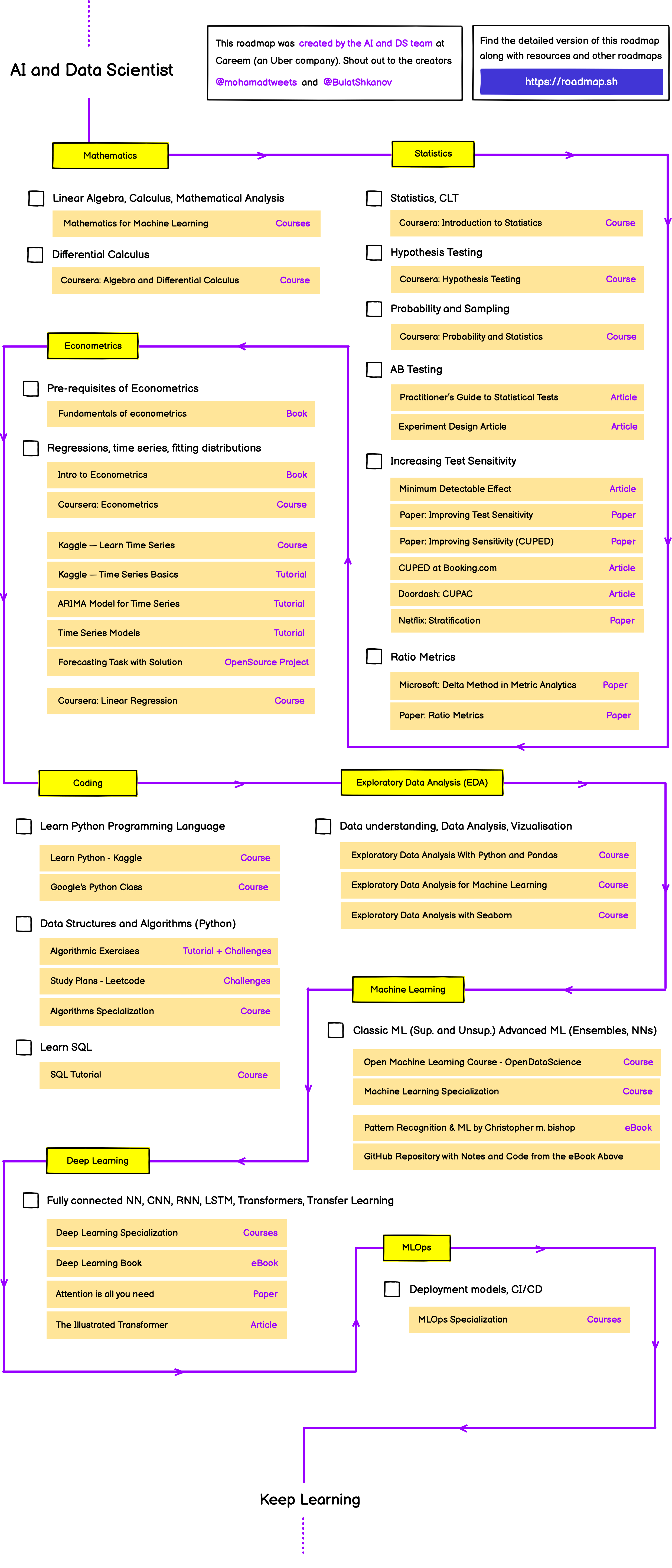
AI & Data Science competency framework following a system-oriented roadmap.
Source: Roadmap.sh. (2025).
AI and Data Scientist Roadmap.
Along this capability axis, an AI learning roadmap can be summarized into several core layers:
-
Python: Beyond basic syntax, the focus is on object-oriented programming (OOP), asynchronous programming, and the ability to build high-performance APIs (using FastAPI or Flask) to serve AI models in production environments.
-
Data: The foundation of modern AI systems. In addition to SQL and ETL pipelines, learners must master vector databases (such as Pinecone, Weaviate, or Milvus) and cloud-based storage solutions like AWS S3. These are critical enablers for deploying effective Retrieval-Augmented Generation (RAG) systems.
-
Applied Machine Learning: Rather than only learning generic algorithms, emphasis should be placed on fine-tuning and specialized architectures. For example, applying Graph Neural Networks (GNNs) to large-scale recommendation systems or complex relational data. This is a key source of technical moat that makes practitioners harder to replace.
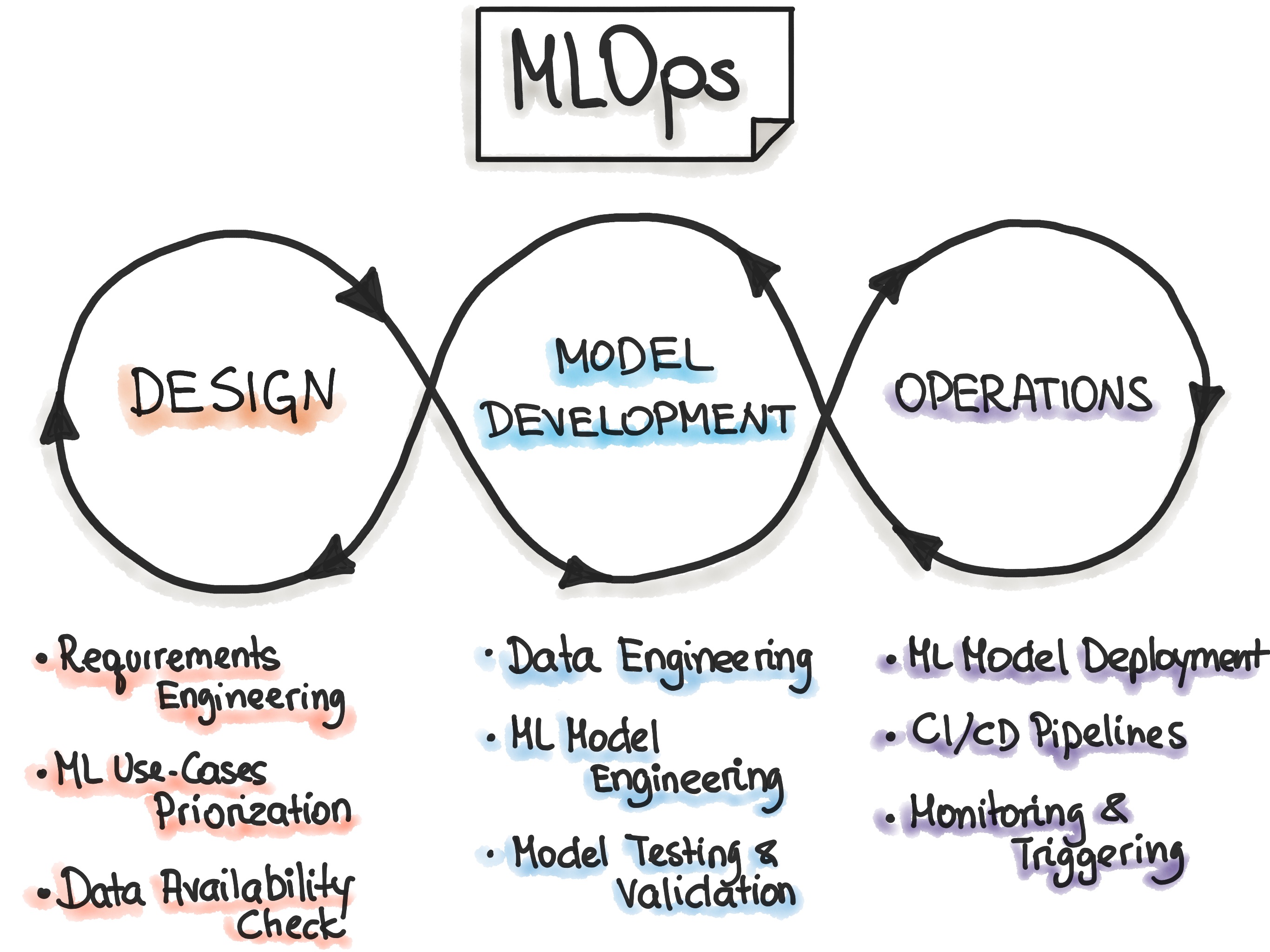
The AI project lifecycle under the MLOps model.
Source: Google Cloud Architecture Center. (2024).
MLOps: Continuous delivery and automation pipelines in machine learning.
-
Deep Learning & Generative AI: Expands the system’s ability to process complex data types such as text, images, time series, and enterprise knowledge bases.
-
MLOps & Cloud Deployment: To move AI beyond experimentation, operational capability is essential. Key focus areas include containerization with Docker, orchestration with Kubernetes, and deploying serverless AI on platforms such as AWS Lambda or Amazon SageMaker. These ensure system scalability and cost optimization (Cloud FinOps).
4.2. A Structured AI Learning Example in Vietnam: AIO (AI VIETNAM)
In practice, many AI learners in Vietnam struggle not due to a lack of resources, but because of the absence of a long-term, structured roadmap with clear discipline and progression. AIO2026 – AI & Data Science is a training program developed and delivered by AI VIETNAM to address this gap.
AIO2026 combines foundational training (Mathematics, Programming, and Computer Science) with advanced modules in Data Science, Machine Learning, Deep Learning, Generative AI, and real-world AI system deployment. The program’s core philosophy is not “fast-track job placement,” but rather building capabilities deep enough to sustain long-term learning, professional work, and research.

A system-oriented AI training roadmap in the AIO2026 program.
Source: AI VIETNAM. (2026).
AIO2026 – AI & Data Science Program.
5. CONCLUSION – LEARNING AI AS A STRATEGIC INVESTMENT
Learning AI in 2026 is no longer confined to a single, predefined career path. Learners may choose to grow as AI practitioners in enterprise environments, pursue academic research at universities and research institutes, or embed AI into their existing domain expertise to create new competitive advantages. In reality, the market increasingly values individuals who can understand research deeply while also adapting and applying that knowledge to specific real-world contexts, rather than treating research and application as two separate worlds.
From this perspective, the question “Is it easy to get a job in AI?” is not about choosing the right job title, but about building capabilities that are both broad and deep enough to move fluidly across roles. Sustainable AI professionals are those with strong foundations, the ability to learn from research, the competence to deploy systems in real environments, and the insight to connect AI with concrete problems in their own domains. Therefore, learning AI is not about mastering a single technology—it is an investment in long-term adaptability.
Before starting (or continuing) their AI journey, learners should clearly identify where they currently stand within the AI ecosystem—tool users, system implementers, or core capability builders—in order to choose a roadmap that aligns with their goals, rather than chasing short-term trends.

The journey of building sustainable AI capabilities in the labor market.
Source: AI-generated illustration.
References
-
ITviec. (2025). ITviec Salary Report 2025–2026. ITviec Vietnam.
-
World Economic Forum. (2025). The Future of Jobs Report 2025.
https://www.weforum.org/reports/the-future-of-jobs-report-2025/ -
World Economic Forum. (2026). Four ways AI and talent trends could reshape jobs by 2030.
https://www.weforum.org/stories/2026/01/four-ways-ai-impact-job-markets -
Pluralsight. (2025). AI Skills Report / Tech Forecast 2026. Pluralsight.
-
PwC. (2025). AI Predictions.
https://www.pwc.com/us/en/tech-effect/ai-analytics/ai-predictions.html -
VnEconomy Techconnect. (2026). Training Trends 2026: AI Is No Longer a Tool but a Core Competitive Capability.
https://vneconomy.vn/techconnect/xu-huong-dao-tao-2026-ai-khong-con-la-cong-cu-ma-la-nang-luc-canh-tranh-cot-loi.htm -
Stanford Institute for Human-Centered Artificial Intelligence. (2025). Artificial Intelligence Index Report 2025. Stanford University.
https://doi.org/10.48550/arXiv.2504.07139
Learning & Technical Resources
-
Roadmap.sh. (2025). AI and Data Scientist Roadmap.
https://roadmap.sh/ai-data-scientist -
DeepLearning.AI. The AI Engineer’s Handbook.
https://www.deeplearning.ai/the-ai-engineers-handbook/ -
McKinney, W. Python for Data Analysis. O’Reilly Media.
-
Géron, A. Hands-On Machine Learning with Scikit-Learn, Keras, and TensorFlow (3rd Edition). O’Reilly Media.
-
Coursera & Andrew Ng. Machine Learning Engineering for Production (MLOps) Specialization.
https://www.coursera.org/specializations/machine-learning-engineering-for-production-mlops -
LangChain. Introduction to Agentic AI & Retrieval-Augmented Generation (RAG).
https://python.langchain.com/docs/introduction/ -
Google Cloud Architecture Center. MLOps: Continuous delivery and automation pipelines in machine learning.
Chưa có bình luận nào. Hãy là người đầu tiên!